Loading...
Introduction
A Deep Tech Startup develops solutions based on novel scientific or engineering knowledge, often combining multiple disciplines. Unlike easily replicable technologies, it involves significant innovation, high technical uncertainty, and thus carries both high risk and high potential. These startups typically require long development timelines and substantial capital investment.
Aligned with Prime Minister Narendra Modi’s clarion call to transition India from a technology consumer to a global “Product Nation”, there is a growing emphasis on deep tech. This vision positions startups as key drivers of frontier innovation and as catalysts for a knowledge-driven economy.
Building a conducive ecosystem supported by strategic incentives, patient capital, and robust intellectual property (IP) protection is essential to enable and safeguard India’s deep tech startups. The National Deep Tech Startup Policy Framework (NDTSP) seeks to address systemic challenges through targeted policy interventions, fostering an enabling environment for innovation-led growth.
Recognizing the critical role of deep technology in advancing economic development and societal progress, the NDTSP establishes a foundational framework for India’s emerging deep tech ecosystem, anchored on four pillars:

Ensuring the Security of India's Economic Future

Facilitating a Seamless Transition to a Knowledge Driven Economy

Bolstering National Capability and Sovereignty through the Atmanirbhar Bharat Imperative

Fostering Ethical Innovation.
NDTSP Development Process
Initiative
The policy initiative was undertaken following a recommendation by the Prime Minister's Science, Technology & Innovation Advisory Council (PM-STIAC) in July 2022 to develop a dedicated policy framework for India’s deep tech startup ecosystem.
Constitution of Consortium
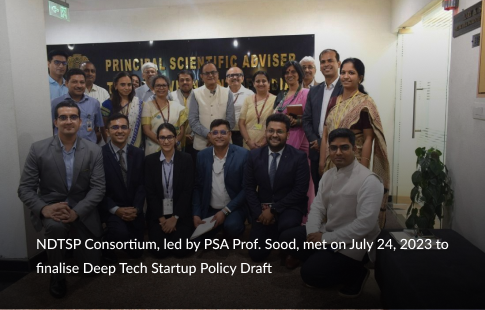
A high-level NDTSP Consortium, chaired by Prof. Ajay Kumar Sood, Principal Scientific Adviser to the Government of India, was established to guide the policy direction. It brought together key industry bodies - Federation of Indian Chambers of Commerce & Industry (FICCI), Confederation of Indian Industry (CII), and National Association of Software and Service Companies (NASSCOM) along with major government stakeholders including Department for Promotion of Industry and Internal Trade (DPIIT), MeitY, DST, ISRO, NSCS, and DRDO.
Formation of Working Group
A dedicated Working Group, chaired by Dr. Parvinder Maini, Scientific Secretary, OPSA was constituted under the consortium to undertake detailed policy design, incorporating inputs from diverse stakeholders across government, industry, and academia.
Core Drafting and Coordination
The Office of the Principal Scientific Adviser served as the central coordinating and drafting body for the NDTSP. Its key roles included:
1. Leading the drafting and iterative redrafting of the policy document
2. Designing the overall policy architecture and thematic structure
3. Conducting multi-stakeholder consultations and synthesizing inputs
4. Facilitating inter-ministerial coordination and alignment
5. Ensuring coherence between strategic vision and implementable policy measures
Consultation and Iteration
Multiple rounds of consultations were conducted with industry, government agencies, and domain experts. Feedback was systematically incorporated into successive versions of the policy.
Draft Submission (October 2023)
The Office of PSA consolidated stakeholder inputs and finalized Version 5.0 of the draft NDTSP, which was formally shared with the Department for Promotion of Industry and Internal Trade to support further policy progression and adoption.
Major Suggestions
Implemented Suggestions
Deep Tech Startup Definition
A gazette notification (February 2026) formalizes an expanded definition of startups with specific emphasis on deep tech characteristics. This enables more targeted support including financial incentives and regulatory measures for high-risk, high-impact ventures.
Deep Tech Fund of Funds (FoF)
A gazette notification (April 2026) announces the launch of Startup India Fund of Funds 2.0 with a corpus of ₹10,000 crore to mobilize venture capital, with expanded focus on deep tech startups. Operational guidelines will incorporate flexibilities tailored to the unique needs of deep tech.
IP and Patent Framework
The Office of the Controller General of Patents, Designs & Trade Marks (CGPDTM) issued revised guidelines for examination of Computer Related Inventions (July 2025), aimed at improving clarity, consistency, and predictability, while aligning India’s patent practices with global standards.